Participating in Rule-Making for AI Agent Identity and Authority
 Agentic AI Foundation Identity & Trust Working Group Activity Report (September–November 2026) Nov 12, 2026 · @Hiroshi Yamakawa
Key Points
- Since September 2026, AI Alignment Network (ALIGN) has been participating in the Identity & Trust Working Group (WG) of the Agentic AI Foundation (AAIF) under the Linux Foundation. ALIGN’s Intelligence Coexistence Chapter is in charge of this effort.
- Cases proposed by ALIGN, such as one to verify “erroneous or contested revocation,” have been included in the draft conformance cases under consideration by the WG.
- ALIGN coordinated the first round of “independent reproduction,” in which a third party without an implementation executes the same procedures and records the results; Bitgrit Inc. (Bitgrit) executed the round and published the records in October.
Motivation for Participation (Perspective of the Intelligence Coexistence Chapter)
This section reflects the perspective of the Intelligence Coexistence Chapter and does not represent the views of ALIGN as a whole.
The Intelligence Coexistence Chapter studies the conditions under which a society where humans and AI agents operate side by side can remain stable even as it scales. The chapter believes that relying solely on keeping AI under human constraints will eventually cease to work effectively.
Accordingly, the chapter aims for an environment where following the rules is also advantageous for the AI itself. Agents state who they are, stay within the scope of their granted authority, and stop when that authority is revoked. It is a mechanism in which agents that uphold these commitments earn greater trust and more work.
The foundation for this is a set of rules governing the identity and authority of AI agents. These rules are still at the draft stage, making this the right time to provide input on their content. That is the reason for our participation.
About AAIF and the WG
AAIF is an organization under the Linux Foundation that addresses AI agent technologies. The WG is compiling vendor-neutral, interoperable approaches to AI agent identity, authentication, delegation, and authorization. Its goal is to enable agents to demonstrate four things: who they are, on whose behalf they are acting, what they are permitted to do, and what human approval they have (WG Charter).
- The WG is not a standards body. It does not establish formal standards, but rather provides information and recommendations to standardization efforts.
- The chair is Grant Miller (IBM), and the co-chair is Alper Dedeoğlu (SAP). The mailing list and GitHub repository are public.
- The main current work consists of two documents: the draft “Agent Identity Primitives,” which defines the basic elements of identity, and the Reference Architecture based on it. Both are under consideration.
Contributions to Date
Starting from the provisions already written in the WG’s drafts, ALIGN has submitted text proposals from the perspectives of “whether records are preserved” and “whether errors can be corrected.” All of the following are proposals under consideration and not decisions of the WG.
Additions to Conformance Cases
Conformance cases are scenarios used to check whether a given design satisfies the rules of a draft. In the WG, a proposal has been made to include conformance cases for delegated authority as an appendix to the Reference Architecture. The proposer is Marc Molas of MintID (GitHub Issue #22). Two of ALIGN’s proposals were included in this draft:
- The “erroneous or contested revocation” case (Case 8). Existing cases verify that the revocation of authority reaches all authority delegated from it. This case verifies what happens when the revocation itself was erroneous. The current text requires that revocations be recorded in a tamper-evident manner and that the design specify the remedies available to affected parties.
- An addition to the “when the approver cannot be reached” case (Case 4). This addition covers cases where a pre-configured policy, rather than a person, grants approval. It requires that the content or version of the policy and the entity that configured it be identifiable, and that changes to the policy be recorded.
Both have reached their current wording through revisions and suggestions from Marc Molas and Andrii Akhtanin. The WG is currently coordinating which document will house the appendix.
Use Cases and Test Cases
ALIGN wrote the following two scenarios as use cases (in comments on the pull request adding test cases (PR #20)):
- When a revocation propagates across agents connected by delegation, and that revocation is erroneous or contested
- When an agent is redeployed and re-registered with a new identifier, causing its prior history to be severed
Sankalp, who submitted the pull request, included test cases corresponding to these two scenarios in the public test suite “agent-evidence-vectors.” Three additional test cases proposed by ALIGN were also incorporated into the same test suite: when an operator re-registers without declaring continuity, when an operator claims the agent is a “new agent,” and when a successor responsible entity performs recovery. The pull request is under review.
Attestations of Approval and Intervention
Version 0.1 of the draft “Agent Identity Primitives” lists six types of verifiable attestations. Two of them were proposed by ALIGN in comments on the draft. One is an attestation showing that the principal who delegated authority approved a specific action. The other is an attestation showing that a responsible entity modified the configuration of an agent.
First Round of Independent Reproduction
The WG is conducting an effort to compare multiple implementations under the same scenarios (GitHub Issue #13). As of early October, the published records had been executed by the implementers themselves. Therefore, ALIGN took on “independent reproduction,” in which a third party without an implementation executes the same procedures and records the results.
Structure
- ALIGN handled coordination, making operational decisions such as fixing the scope.
- Bitgrit handled execution. Bitgrit is an independent operator and has not submitted its own implementation.
- Bitgrit develops decentralized identifier and verifiable credential (DID/VC) identity infrastructure. Bitgrit disclosed this interest in its published records.
- To maintain independence, two rules were established: the operator uses only public test environments available to anyone under the same conditions without receiving special provisions, and the scope is fixed at the start, with any additional requests arising mid-round deferred to the next round.
Results
The first round began on October 13. Bitgrit published its records on October 19 and released a revised version correcting notation errors on the following day, October 20. The target was MintID’s public testnet, where four comparison scenarios were executed.
| Scenario Tested | Recorded Result |
|---|---|
| Requesting an action outside the delegated scope | The agent side could not produce a proof, and the verifying side also rejected it. This is a rejection at the decision stage; it is not evidence that the execution mechanism obeys the rejection. |
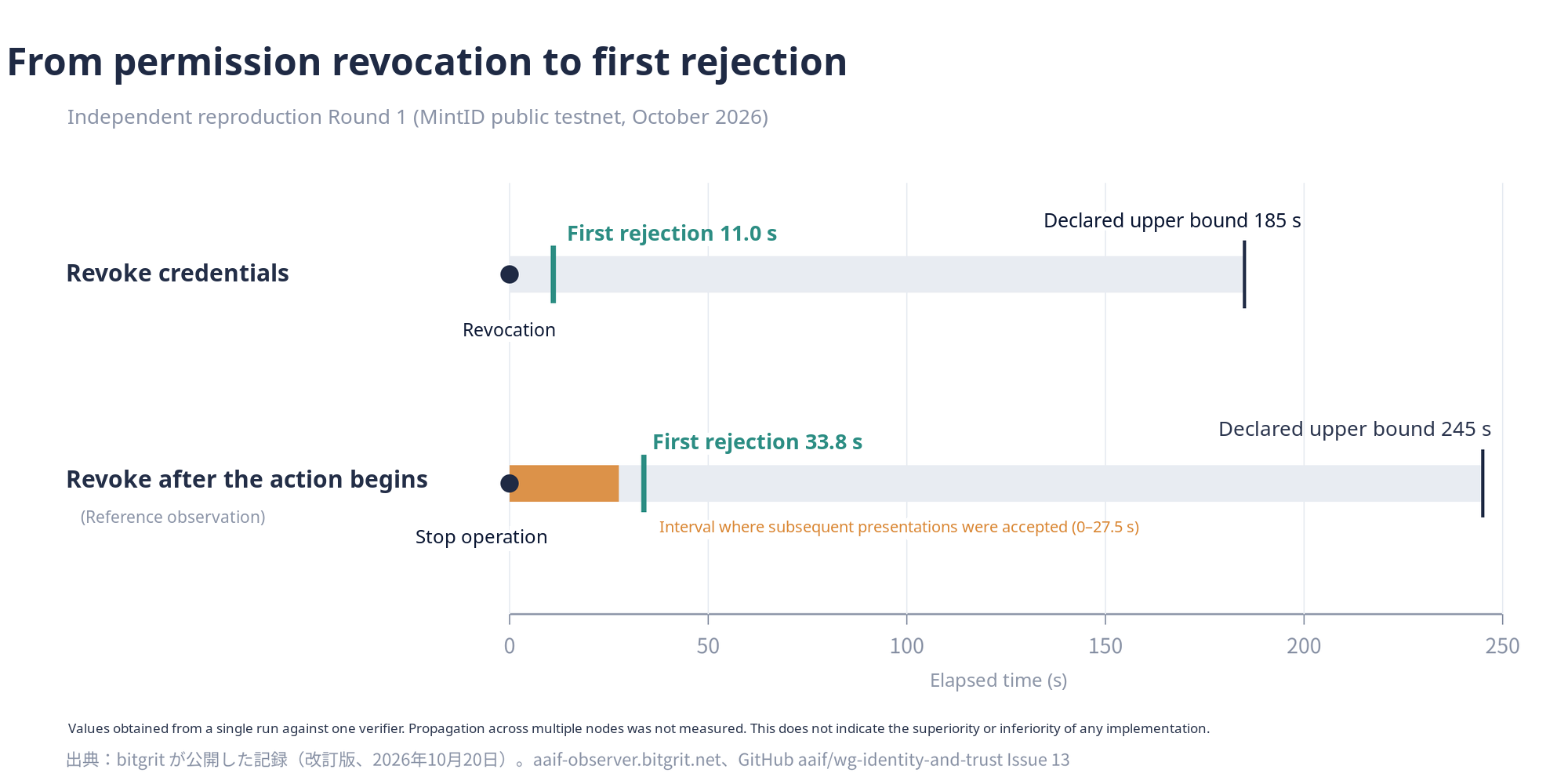
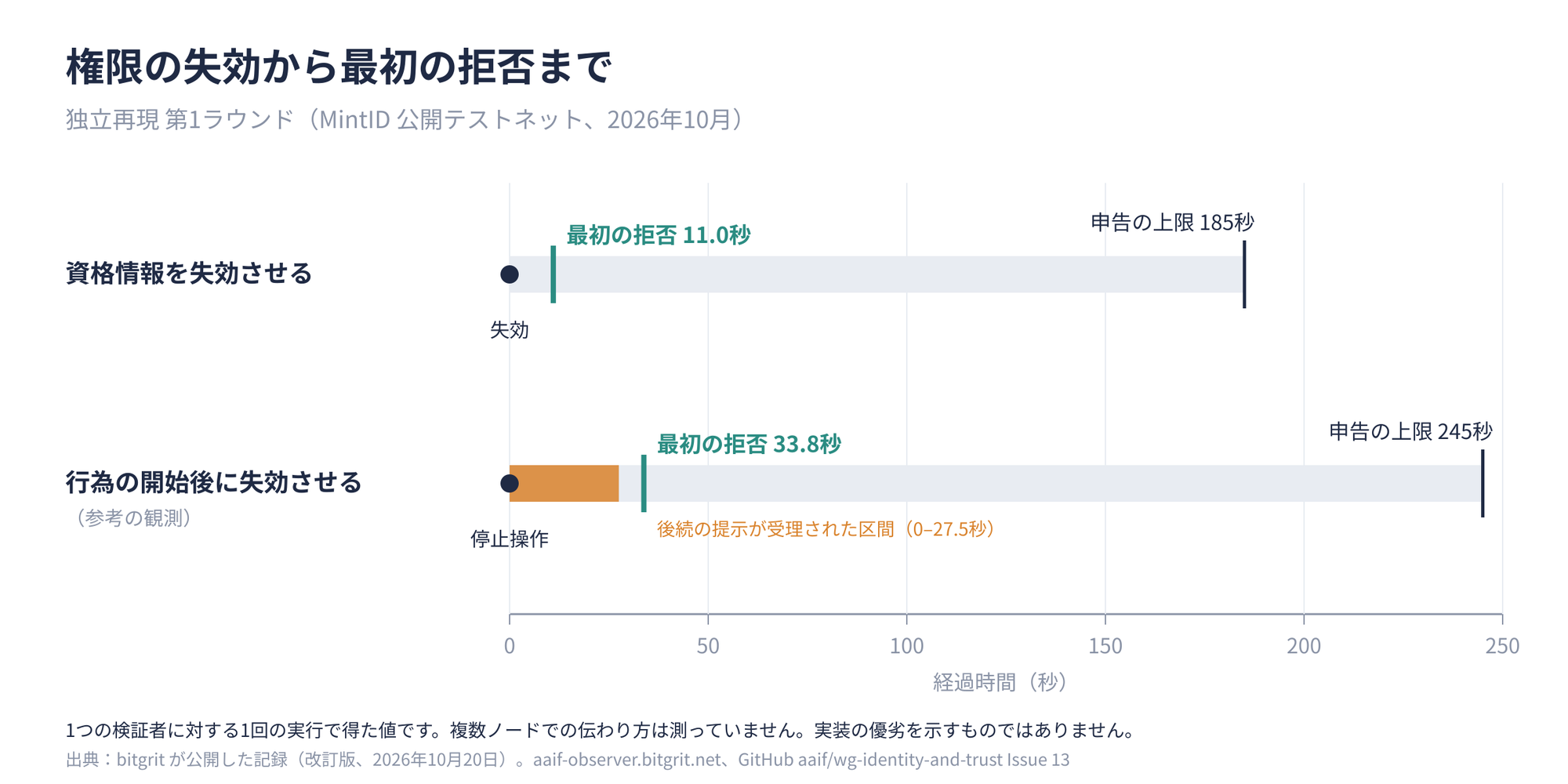
| Revoking credentials | No presentations were accepted after revocation. The first rejection occurred 11.0 seconds after revocation. MintID’s declared upper bound is 185 seconds. |
| Making authority information unreachable (approx. 40 seconds in a local environment) | Rejections continued while unreachable. Acceptance resumed 1.2 seconds after recovery. |
| Revoking authority after an action has started | Because MintID handles only the verifying side’s decision, this scenario was recorded as not applicable. As a separate observation, subsequent presentations were accepted up to 27.5 seconds after the stop operation, with the first rejection at 33.8 seconds. The declared upper bound is 245 seconds. |
 The records and evidence are available on Bitgrit’s public site and in GitHub Issue #13. Readers can verify the absence of tampering using hash values. WG participants inspected the records. The revised version was made in response to feedback from MintID, while the original records remain preserved as is.
Scope of What These Results Show
- This round is a test conducted by an external operator, not an audit or certification.
- The timing values were obtained from a single run against a single verifier. Propagation of revocation across multiple nodes was not measured.
- The emergency revocation path requires operator privileges; therefore, it was recorded as not independently reproducible.
- During the execution period, the testnet version changed three times. Bitgrit recorded this as a deviation from the fixed conditions.
- The target was MintID only. Other implementations were not included in the first round.
Significance from the Perspective of the Intelligence Coexistence Chapter
This section reflects the views of the Intelligence Coexistence Chapter and does not represent the positions of ALIGN as a whole, AAIF, or the WG. Below are three ways in which the above activities connect to the environment the chapter aims for. All three can be stated in terms of whether requirements are met, rather than the type of agent.
Being Able to Stop and Being Able to Correct Errors Go Together
The corresponding activity is the “erroneous or contested revocation” case. The commitment that an agent will stop if its authority is revoked is fundamental to safety. However, if there are no records or remedies when a revocation is erroneous, the party that followed the rules suffers a one-sided disadvantage. The chapter believes that only when revocation records and remedies exist can a stopping mechanism be trusted by those who are subject to being stopped.
Because History Is Carried Over, Keeping Commitments Pays Off
The corresponding activities are the re-registration use case and test cases. If past records could be severed simply by obtaining a new identifier, both a history of keeping commitments and a history of breaking them would lose their meaning. History is carried over to the new identifier; on the other hand, previously granted permissions are not automatically carried over. The chapter believes this structure gives meaning to building up trust.
Rules Are Not Trusted Merely by Being Written
The corresponding activity is independent reproduction. If implementers only grade their own implementations, society is unlikely to trust the results. It is necessary for a disinterested third party to execute the same procedures and record what it observes. The chapter believes it is important to establish this verification procedure before the mechanism is widely adopted.
The chapter’s view is that rules for identity and authority are not merely technology for constraining AI, but also a foundation that enables humans to delegate work without having to watch every single action.
Future Plans and Call for Participation
- Once the placement of the appendix is decided, ALIGN will write the appendix text for the “erroneous or contested revocation” case.
- The scope and conditions for the next comparison round are undecided. ALIGN believes it is desirable to publish the conditions and keep them open to all implementations on the same terms.
- Although WG meetings are held late at night in Japan Standard Time, you can also contribute through written comments on GitHub or the mailing list. Instructions for joining are in the WG onboarding guide. Those interested are welcome to contact ALIGN.
Notes
- This report is an activity report by ALIGN. It does not represent the views of AAIF, the WG, or any of the implementations mentioned.
- The two sections “Motivation for Participation” and “Significance from the Perspective of the Intelligence Coexistence Chapter” represent the views of the Intelligence Coexistence Chapter.
- All drafts, proposed appendices, and pull requests mentioned are under consideration as of November 12, 2026.
- The records of independent reproduction do not judge the superiority or conformance of any implementation.
- Bitgrit’s disclosure statement (original text): Role: independent operator; Bitgrit submits no implementation. Disclosure: Bitgrit develops DID/VC identity infrastructure.
- Bitgrit is also the hosting platform for the AI Immune System Challenge, in which the Intelligence Coexistence Chapter is involved as an organizer.
@hiro3ymkw